
You're good at what you do. You've been doing it for years. Your customers refer you to their friends. And yet, when someone in London types "electrician near me" or "HVAC company Southwestern Ontario" into Google — your name doesn't show up.
Someone else does. Maybe a company you've never heard of. Maybe one you know isn't as good as you.
This is one of the most frustrating things we hear from trades businesses. And it's fixable. Not overnight, but with steady, deliberate work — the kind that actually lasts.
Here's what's usually going on, and what to do about it.
Not long ago, trades businesses got most of their work through word of mouth, yard signs, and the phone book. Referrals still matter — they're still often the best leads — but the way new customers find you has shifted dramatically.
When someone moves to a new neighbourhood and their furnace stops working, they don't ask around first. They Google it. When a property manager needs a reliable electrician for ongoing work, they search. When a homeowner wants three quotes on a renovation, they go to Google and pick the ones that show up.
If you're not there, you're not in the running. It's that simple.
The good news is that local trades SEO — getting your business to show up for searches in your area — is very achievable. You don't need to outrank Home Depot. You need to outrank the three or four other local companies competing for the same jobs you want.
This is the single biggest missed opportunity we see with trades businesses.
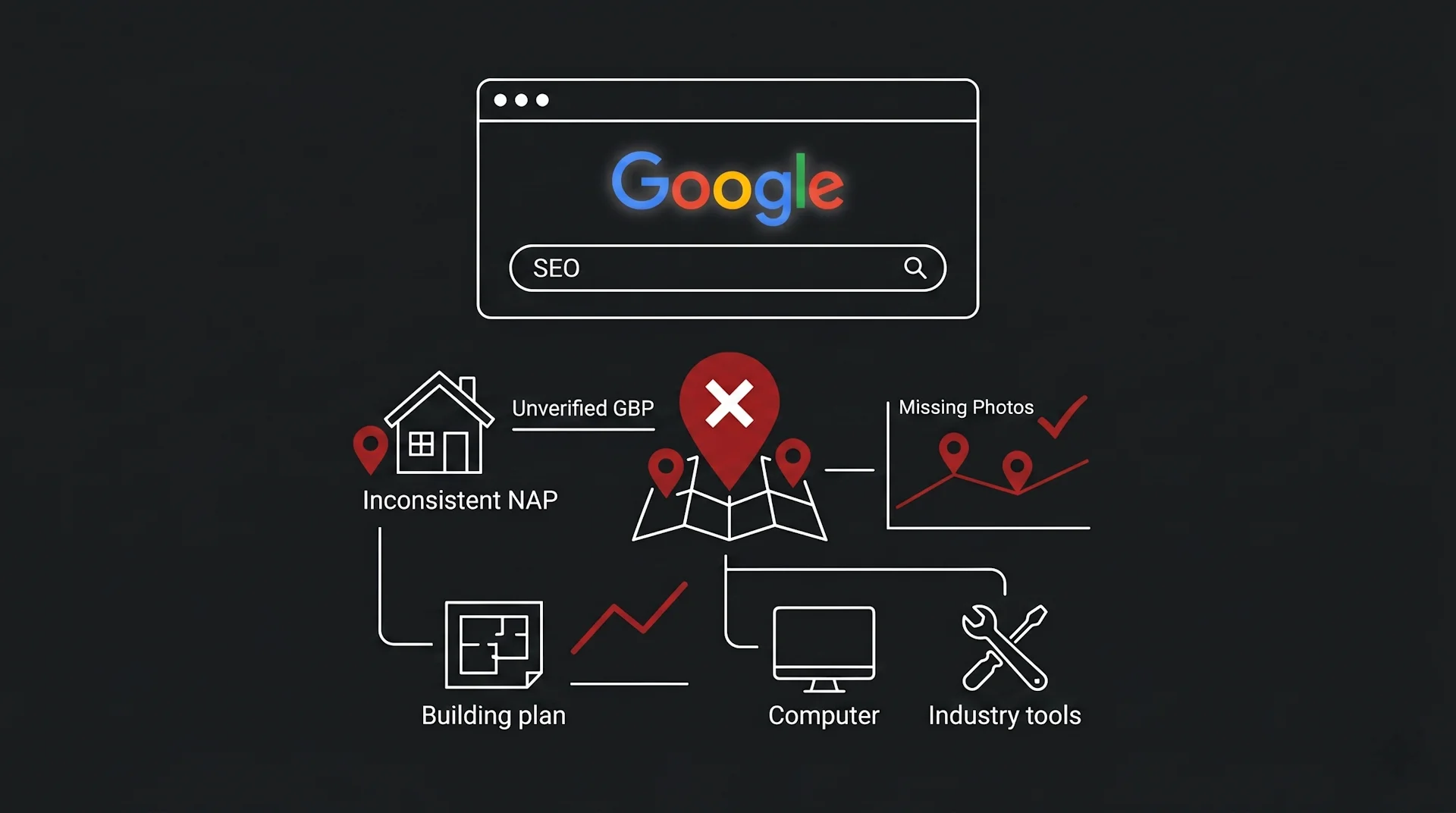
Google Business Profile (formerly Google My Business) is the listing that shows up in the map results — the ones with stars, photos, and a phone number right at the top of the search results page. For local service businesses, this is often more important than your actual website.
If you haven't claimed your listing, Google may have created a partial one automatically — with wrong information, no photos, and no way for customers to leave reviews. Or it may not exist at all.
What to do:
- Go to business.google.com and claim or create your listing
- Fill in every field completely — hours, service area, phone, website, description
- Add real photos of your work, your truck, your team
- Choose the right primary category (be specific — "Electrical Contractor" not just "Contractor")
- Start asking happy customers to leave Google reviews
A fully optimized Google Business Profile alone can move you from invisible to showing up for local searches, without touching your website at all.
Google needs to understand not just what you do, but where you do it. A lot of trades websites are vague about this — they say "serving the area" without specifying what area, or they only mention their city once in the footer.
If you want to show up for "plumber in London Ontario" or "HVAC company Woodstock," those words need to actually appear on your website — in your page titles, your headings, your content.
What to do:
- Make sure your city and service area are in your page title (the text in the browser tab)
- Include your location naturally in your page copy — not stuffed awkwardly, just mentioned clearly
- If you serve multiple towns, consider a short page for each one: "Serving St. Thomas," "Serving Strathroy," etc.
- Put your full address, phone number, and city in the footer of every page
When Google shows your site in search results, it shows two things: the title of the page, and a short description. If you haven't set these intentionally, Google will guess — and its guess is usually bad.
"Home — WordPress Site" is not a helpful title. "Welcome to our website" is not a compelling description.
What to do: Every page on your site should have a specific title that includes what you do and where you do it. Something like:
- "Residential Electrical Services in London, Ontario | Your Company Name"
- "HVAC Installation & Repair | Serving London and Southwestern Ontario"
These don't need to be clever. They need to be accurate and specific.
There's a category of website problems that you'd never notice as a visitor, but that make it much harder for Google to index and rank your site.
Common ones include:
- Slow load times — Google uses page speed as a ranking factor, especially on mobile
- Not mobile-friendly — More than half of local searches happen on phones. If your site is hard to use on a phone, Google notices.
- Broken links — Pages that lead nowhere signal an unmaintained site
- Missing or duplicate page titles — Confuses Google about what each page is about
- No SSL certificate — Sites without https:// get flagged as "not secure" and rank lower
A basic technical audit will surface most of these. Many are straightforward to fix.
Google decides how trustworthy a website is partly by looking at who links to it. A link from another website is essentially a vote of confidence.
For a local trades business, you're not trying to get linked to by the New York Times. You're trying to get linked to by:
- Local business directories (Yellow Pages, Yelp, BBB, Houzz)
- Your local Chamber of Commerce
- Supplier or manufacturer directories (if you're a certified installer for a brand)
- Local news sites, if you've ever been mentioned
- Partner businesses — the general contractor who always refers you, for example
What to do: Start by making sure you're listed consistently across the major directories. Your business name, address, and phone number should be identical everywhere — even small inconsistencies (St. vs Street, for example) can confuse Google.
Then think about who in your network has a website and might mention you.
Reviews matter for two reasons. First, they influence whether customers call you. Second, Google uses review signals as a local ranking factor — businesses with more recent, positive reviews tend to rank higher.
Many trades business owners feel awkward asking for reviews. Get over it. Customers who are happy with your work are usually glad to help — they just need to be asked.
What to do: After every job that went well, send a quick follow-up text or email with a direct link to your Google review page. Make it as easy as one click. Ask for honest feedback, not a specific star rating — it comes across better and Google can tell the difference.
When you get reviews, respond to all of them — the positive ones and the negative ones. It shows you're attentive and professional.
Google favours websites that are active — that get updated, that add content, that show signs of life. A site that was built in 2018 and hasn't changed since sends a signal that the business might not be paying attention.
This doesn't mean you need to post three blogs a week. It means:
- Keeping your hours, contact info, and services up to date
- Adding new photos when you complete a good job
- Writing occasional content that answers questions your customers actually ask
Which brings us to the last point.
When a homeowner is wondering whether to repair or replace their furnace, or trying to understand what an electrical panel upgrade actually involves, they search for that information. If your website has a page that genuinely answers that question — in plain English, by a real local expert — Google will show it to them.
Most trades websites have five pages: Home, About, Services, Gallery, Contact. That's fine as a foundation. But it doesn't give Google much to work with, and it doesn't give potential customers a reason to find you before they're ready to call.
A few helpful articles or FAQ pages — written by someone who actually knows the trade — can make a significant difference over time.
If your budget and time are limited, here's the order we'd recommend:
- Claim and complete your Google Business Profile. This is free and often has the fastest impact.
- Get your NAP consistent across directories. Name, address, phone — identical everywhere.
- Fix the obvious technical problems — mobile-friendliness, page speed, SSL.
- Add location-specific text to your key pages. Don't overdo it. Just be clear about where you work.
- Ask for Google reviews. Consistently. After every good job.
- Add some helpful content. Start with the two or three questions you answer most often on the phone.
None of this is magic. It's just methodical, consistent work — the same kind of work that makes a good trades business in the first place.
A few honest things to set expectations:
SEO is not fast. If someone promises you page-one rankings in 30 days, they're either lying or using tactics that will hurt you later. Legitimate SEO takes months to show significant results.
SEO is not a one-time fix. A site optimized today will drift without ongoing attention. Your competitors are working on theirs too.
SEO is not right for every business at every stage. If you have more work than you can handle through referrals, pouring money into SEO might not be the highest-leverage thing you can do right now. We'll tell you that if it's the case.
We work with a lot of trades and industrial businesses across Southwestern Ontario. We know what the local competitive landscape looks like, what's actually achievable, and what's worth spending money on.
We're happy to take a look at where you stand and give you a straight answer — at no charge and with no obligation to work with us.