
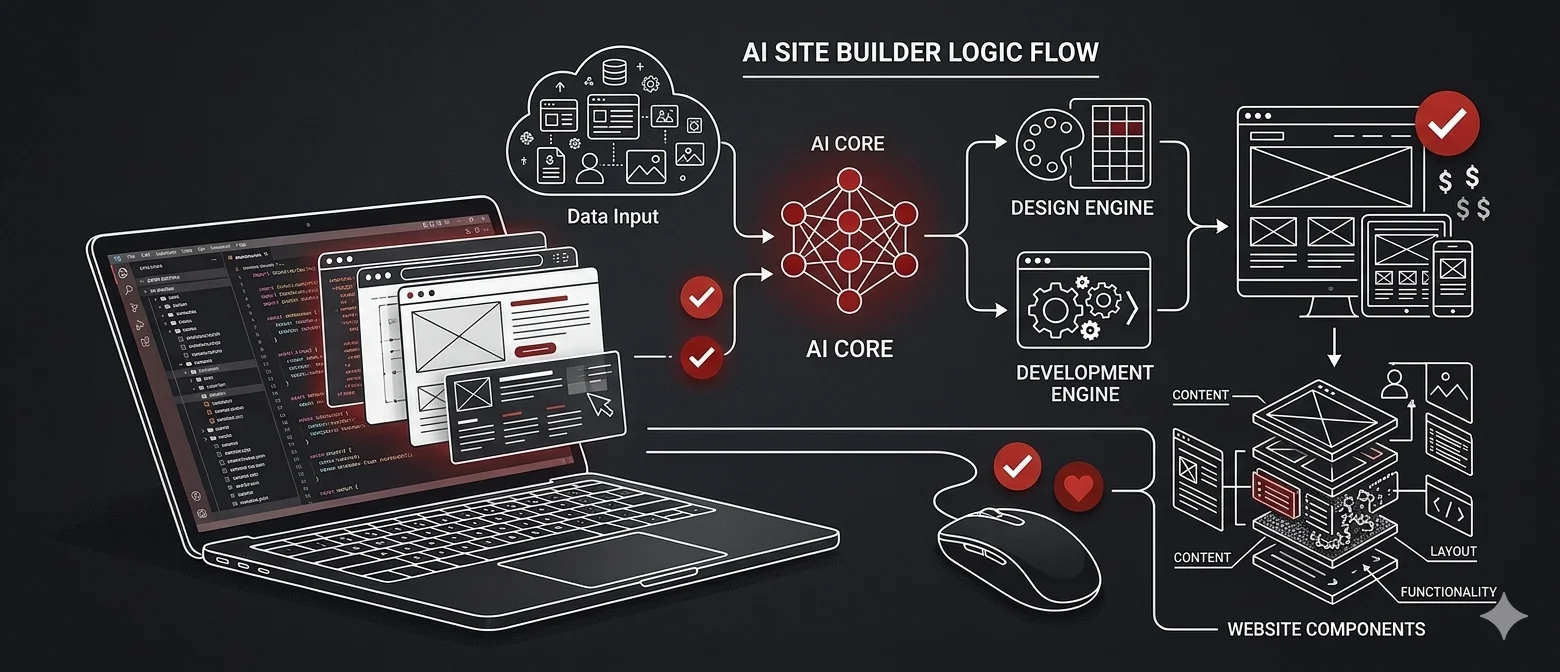
We're a web agency. We built our own website using AI as a core part of the development process. We think that's worth being transparent about — both because it's genuinely interesting and because it's relevant to anyone considering working with us or wondering what AI-assisted development actually means in practice.
This isn't a post about how AI is magic. It's an honest look at what worked, what didn't, and what it means for the work we do for clients.
We've been building websites since 2011. We know how to build a site the traditional way. We chose to lean into AI-assisted development on this project deliberately — partly to push ourselves, partly to see what was genuinely possible, and partly because the result you're looking at is a direct demonstration of what we can offer clients.
If we're going to tell you that AI has changed what's accessible to small businesses, we should be able to show you what that looks like. This site is that demonstration.
This isn't a WordPress site. It isn't Squarespace. It isn't built on any off-the-shelf platform.
It's a custom PHP application with a database, a full content management system, a client portal, a ticketing system, an onboarding questionnaire, a blog, a redirects manager, a contact form with multi-step logic, and an admin panel where every piece of content can be managed without touching code.
The design uses a custom CSS system built from scratch with a full set of design tokens — typography scale, colour palette, spacing, component library. Every page is server-side rendered for performance and SEO. The structured data, meta tags, sitemaps, and canonical URLs are all handled automatically.
This is not a small project. Traditionally, a build like this would take months and cost significantly more than what a small agency's own website budget typically allows.
We built it in a fraction of that time.
Execution speed. The most obvious gain. Writing the boilerplate for a new controller, building out a database schema, implementing a standard component — these things that used to take a morning now take an hour. Over the course of a full build, that compresses the timeline dramatically.
Consistency. When you're building a system with many moving parts, keeping patterns consistent across dozens of files is tedious work that's easy to get wrong. AI is excellent at maintaining consistency — applying the same approach to the tenth instance of something the same way it did to the first.
Iteration. Trying a different approach to a UI component, refactoring a section of code, exploring an alternative layout — these used to feel expensive because of the time involved. When iteration is fast, you do more of it, which leads to better results.
Documentation and structure. Keeping track of decisions, maintaining clean code, writing inline comments — AI handles this naturally as part of the work rather than as an afterthought.
Judgment. This is the big one. AI has no opinion about whether a design decision is actually right for the business. It will build whatever you ask it to build. Deciding what to build — the strategy, the information architecture, the copy, the user experience decisions — that's all human work. The AI accelerated the execution of those decisions. It didn't make them.
Knowing what to ask. The quality of AI output is directly proportional to the quality of the input. Knowing how to describe a problem clearly, anticipate edge cases, specify constraints, and evaluate output critically — that takes experience. Someone without a development background using the same tools would get very different results.
Debugging complex interactions. When something unexpected happened — and things always happen unexpectedly in complex systems — the debugging process was still fundamentally human work. AI could help narrow things down, but the diagnosis required understanding the system as a whole.
Design taste. AI can implement a design. It cannot develop taste. The visual decisions — the typography, the colour relationships, the spacing, the overall aesthetic — came from experience and judgment, not from prompts.
The honest summary: AI made us significantly faster and allowed us to build a more ambitious project than would have been practical otherwise. It did not replace the work — it accelerated it.
For clients, that translates to a few concrete things:
More is possible. Custom functionality that used to require a larger budget is now in reach for smaller businesses. The things we described above — client portals, custom tools, booking systems, admin panels — are genuinely accessible now in a way they weren't two or three years ago.
Faster timelines. A project that used to take three months might take six weeks. That's real.
Better iteration. Because changes are faster to implement, we can try things and adjust more readily. The first version doesn't have to be perfect because getting to the second version doesn't cost as much as it used to.
Same accountability. The speed is different. The responsibility isn't. We still own the work, we still stand behind it, and we're still the ones answering the phone when something needs attention.
We've been doing this for 14 years. The honest truth is that AI has made this work more interesting, not less.
The tedious parts are faster. The creative parts — the strategy, the problem-solving, the decisions about what to build and why — are more prominent. We spend more time thinking and less time on mechanical work.
And the range of what we can offer has expanded in a way that genuinely excites us. Ideas that clients used to set aside because they seemed too ambitious, too complex, or too expensive — we're building those now.
If you have one of those ideas, we'd like to hear it.